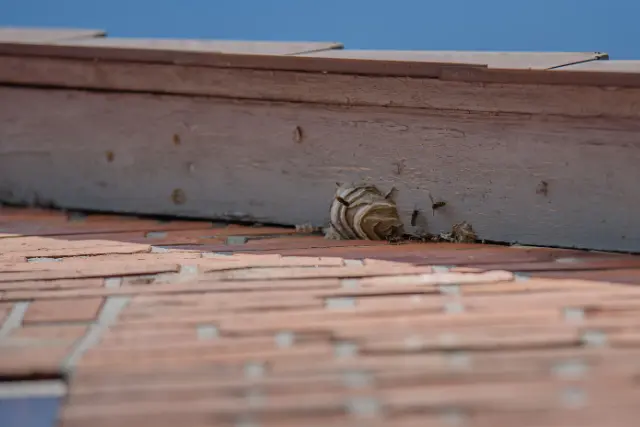
You’re out in the yard, checking on the garden or grilling dinner, and you spot it. A gray, papery nest tucked under the eave of your roof, hanging from a tree branch, or wedged into the corner of your porch. It’s a wasp nest, and it’s closer to your front door than you’d like.
Finding a wasp nest near your home can be stressful, especially if you have kids or pets. Here’s what to do, what to avoid, and when to call for help.
Don’t Panic — But Don’t Ignore It
A small wasp nest in early spring may only have a few wasps. But wasp colonies grow fast. By summer, a nest that started with a single queen can hold hundreds or even thousands of wasps. The longer you wait, the bigger and more aggressive the colony becomes.
If the nest is in an area where people walk, play, or gather, it needs to be dealt with sooner rather than later. Wasps are territorial. They will sting to defend their nest, and unlike bees, wasps can sting multiple times. For people who are allergic, even a single sting can cause a serious reaction. If someone experiences swelling beyond the sting site, difficulty breathing, or dizziness after a sting, the Mayo Clinic recommends seeking emergency medical care right away.
What NOT to Do
Your first instinct might be to knock the nest down with a broom or spray it with a garden hose. This is a bad idea. Disturbing a nest makes the wasps aggressive and puts you at risk of multiple stings. Here are the most common mistakes people make.
Hitting or shaking the nest. Spraying it with water. Using fire or smoke near the nest, which is a serious safety hazard. Trying to remove it at night without proper gear. Using store-bought sprays on large or hard-to-reach nests.
While some DIY pest control methods work well for certain pests, wasps are one situation where doing it yourself can backfire quickly. Our guide to DIY pest control explains when it makes sense to handle things on your own and when it’s time to call a professional.
Identify the Type of Wasp
Knowing what type of wasp you’re dealing with helps determine the best approach. Here are the three most common types in the Jersey City area.
Paper wasps build small, open nests that look like upside-down umbrellas. You’ll find them under eaves, porch ceilings, and deck rails. They’re generally less aggressive unless the nest is disturbed. Their nests are easy to spot because the individual cells are visible.
Yellow jackets are more aggressive. They often nest underground in old rodent burrows, but also build nests in wall voids and attics. They’re attracted to food and sugary drinks, which makes them a problem at outdoor gatherings. Yellow jackets are responsible for most wasp stings because they nest in hidden spots where people accidentally step on or disturb the colony.
Bald-faced hornets build large, enclosed nests in trees or on the sides of buildings. These nests can grow to the size of a basketball by late summer. They’re highly defensive and will attack in numbers if they feel threatened.
When to Call a Professional
You should call a pest control professional if the nest is larger than a golf ball, if it’s in a spot that’s hard to reach like inside a wall or high up on the roof, if you or someone in your household is allergic to stings, or if you’ve already tried to remove it and the wasps came back.
Professional wasp removal is fast and safe. A trained technician will identify the species, apply the right treatment, and remove the nest completely. They’ll also check for secondary nests nearby, since wasps sometimes build more than one nest on the same property. Most professional removals take less than an hour, and the area is safe to use again the same day.
How to Prevent Wasp Nests
Once the nest is removed, there are steps you can take to keep wasps from coming back. Seal any gaps or cracks in your home’s exterior, especially around the roofline, soffits, and vents. Keep trash cans tightly covered. Avoid leaving sweet drinks or food outside for long periods. Check your yard, eaves, and garage in early spring for new nests when they’re small and easier to handle.
Early spring is the best time to act. A queen is just starting to build her nest, and the colony is small. Catching it early means less risk and a quicker fix. If you wait until summer, the colony will be much larger and harder to deal with safely.
Get Help in Jersey City
Jersey City Exterminators handles wasp and hornet nest removal across Jersey City, Hoboken, Bayonne, Union City, and all of Hudson County. If you’ve found a nest near your home, don’t take chances. Call (201) 460-6068 for same-day service.