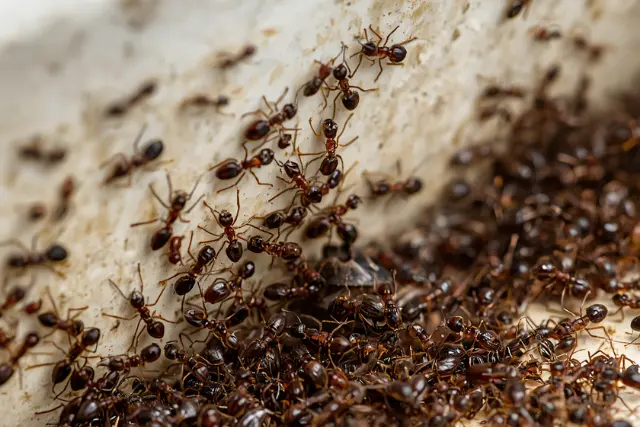
If you live in Jersey City, you probably already know the drill. As soon as the weather warms up in March and April, the ants show up. They march across your kitchen counter. They trail along your baseboards. And no matter how much you clean, they keep coming back.
Spring is the worst time of year for ant problems in New Jersey. Here’s why it happens, what to look for, and what you can do about it.
Why Do Ants Come Out in Spring?
Ants don’t disappear in winter. They hibernate deep in the soil or inside the walls of your home. When spring temperatures climb above 50°F, ants wake up hungry. Entire colonies send out scouts to find food and water. Once a scout finds something, it leaves a scent trail for thousands of other ants to follow.
That’s why you can go from seeing one ant to seeing hundreds in just a day or two. The colony doesn’t send a few ants. It sends an army.
Jersey City’s mix of older row homes, brownstones, and apartment buildings makes things worse. Many of these buildings have small cracks in the foundation, gaps around pipes, and aging window frames. These openings are all an ant needs to get inside. Neighborhoods like Jersey City Heights and Downtown have some of the oldest housing stock in the area, which means more entry points for pests. If you want to learn more about sealing up your home, check out our guide to pest-proofing your home for long-term protection.
Common Ants in Jersey City
Not every ant you see is the same. Jersey City homes deal with a few different species, and each one causes different problems.
Pavement ants are the most common. They’re small, dark brown, and love sweet and greasy foods. You’ll see them trailing along countertops and near pet food bowls. They get their name because they often nest in cracks in sidewalks and driveways, but they’ll move indoors when food is available.
Carpenter ants are larger and black. They don’t eat wood, but they tunnel through it to build nests. Over time, they can cause real damage to wooden beams, door frames, and window sills. If you see large ants with wings inside your home, you may have a carpenter ant colony living in your walls. Carpenter ants prefer damp or water-damaged wood, so homes with moisture problems are at higher risk.
Odorous house ants are tiny and give off a rotten smell when crushed. They love moisture and often nest near leaky pipes or damp bathrooms. These ants can have multiple queens in a single colony, which makes them harder to eliminate with store-bought sprays.
Signs You Have an Ant Problem
A few ants on the counter might not seem like a big deal. But it usually means there are many more hiding nearby. Watch for these signs that the problem is getting worse.
Visible trails of ants moving in a line, especially near food or water sources. Small piles of dirt or sawdust near baseboards, which can point to carpenter ants. Ants appearing in bathrooms or near plumbing, which signals a moisture issue. Winged ants indoors in spring, which means a colony is nesting inside your home and sending out new queens to start fresh colonies elsewhere.
What You Can Do Right Now
A clean home helps, but cleanliness alone won’t stop ants. Here are a few steps you can take today.
Wipe down counters and tables after every meal. Store all food in sealed containers, including pet food. Take out the trash every day. Fix any leaky faucets or pipes, since ants are drawn to moisture. Seal cracks around windows, doors, and where pipes enter the wall. Move firewood, mulch, and leaf piles away from your foundation, since ants use these as nesting sites close to your home. The EPA recommends sealing cracks, storing food properly, and removing easy access to water as the first steps before reaching for any pesticide.
These steps slow ants down, but they won’t eliminate a colony that’s already established in your home.
When to Call a Professional Ant Exterminator
If ants keep coming back after you’ve cleaned and sealed entry points, the colony is likely nesting inside your walls or foundation. Store-bought sprays kill the ants you can see, but they don’t reach the queen. As long as the queen is alive, the colony keeps growing. Some colonies have tens of thousands of workers, so killing a few dozen on the counter barely makes a dent.
A professional ant exterminator can identify the species, locate the nest, and apply treatments that reach the entire colony. This is especially important with carpenter ants, which can cause hidden structural damage if left untreated. A trained technician will also identify the conditions that attracted ants in the first place and recommend steps to prevent them from coming back.
Jersey City Exterminators provides ant control services across Jersey City Heights, Downtown, Newport, the West Side, and surrounding areas in Hudson County. If you’re seeing ants this spring, call (201) 460-6068 for same-day service.